Problem Background
Objective
The objective of World System Beta is to create a clean-slate base world system that humans are in the process of building on the Moon. It is a perfect test ground to compare against World System Alpha, which represents an idealized version of the world system on Earth.
Throughout the development of World System Beta, the following objectives are to be met:
Establish the foundation of World System Beta using Agent-Based Modeling (ABM) and Discrete Event Simulations (DES) to model dynamic interactions, emergent behaviors, and systemic dependencies.
Validate baseline performance and expose vulnerabilities, using structured experiments to evaluate system behavior under defined policies.
Optimize internal flows and feedbacks using both system dynamics and learned control models.
Enable adaptation, resilience, and decentralized intelligence.
Compare system performance before and after adaptive logic integration.
Consolidate adaptive and control-informed policies into a reusable governance layer.
Introduce socio-political dimensions.
Map how robust adaptive policies are to variable conditions.
Explore how external policies influence internal system behavior.
Codify adaptive policies and export them to World System Alpha.
Constraints
The initial world system Beta is constrained to plans and operations defined as part of Artemis program. This is to provide a controlled environment that has some realistic odds of success.
Functional Description
Simulation Functions and Capabilities
This section defines the simulation’s functional contract—what Proxima can do and how it is organized. It specifies core agent behavior (operational modes, task/telemetry interfaces, lifetime and health), describes how parametric world-system goals are injected and updated at runtime, and explains how sectors translate those goals into priority-weighted schedules and assignments under real-world constraints (power, comms, spares, safety). It also outlines closed-loop adaptation (recomputing priorities from observed state and goal deviation) and the provenance requirements for traceability (versioned goals, derived priorities, and scheduling decisions). Detailed algorithms and implementation choices appear in later sections; this section focuses on roles, interfaces, and capabilities.
Core Agent Functions
Operational modes: Each agent implements one or more mutually exclusive operational modes (e.g., idle, active, maintenance, fault-handling). At any time, exactly one mode is active; mode transitions follow defined preconditions and safety checks.
Mode control vs. goals: Agents are goal-agnostic—they do not store or reason about global world-system goals or priorities. Mode changes are commanded by their sector’s scheduler/policy layer, which interprets goals and translates them into local assignments.
Task interface: Agents receive tasks with inputs, required resources, and acceptance criteria; they return status, outputs, and telemetry (including health and consumption metrics).
Lifetime & health: Each agent has a lifetime and health state (e.g., age, wear, fault counters). End-of-life or degraded health triggers policy-driven actions (derating, maintenance, swap-out, retirement).
Goals Injections and Updates
Parametric goals: World-system goals are expressed in parametric form (metric, target/bounds, horizon, weight), enabling versioning, comparison, and optimization.
External updates: Authorized external actors (human or supervisory policy engine) may inject new goals or modify existing ones at runtime. All changes are timestamped, versioned, and auditable.
Goal interpretation: The world system translates global goals into sector-level policies.
Scheduling & assignment: Each sector applies uses the applied policies to meet the goals to assign concrete tasks to its agents.
Closed-loop adaptation: Sectors periodically recompute priorities based on goal deviation and performance. Policies may adapt automatically (auto-mode) or be updated manually (manual-mode) with immediate effect.
System Performance Monitoring Against Goals
System performance is continuously monitored by the Evaluation Engine at each simulation step. The engine aggregates metric contributions from all active sectors to maintain a live state of system-wide performance indicators. These indicators are then compared against predefined Performance Goals to calculate a normalized score (0.0 to 1.0) and determine a status (e.g., “within” or “outside” limits). The resulting EvaluationResult, containing all metrics, scores, and statuses, provides a comprehensive, data-driven snapshot of goal attainment that informs the Policy Engine and other adaptive systems.
Growth
(Content TBD)
Policy Injection
(Content TBD)
Event Scenario Injections
(Content TBD)
Advancement
This section defines how the world system progresses through stages using explicit stage profiles (preconditions, postconditions, unlocks, and evaluation rules). Progress is data-driven: if civilization behavior deviates (better or worse), advancement accelerates or slows accordingly.
Stage profile:
Preconditions: Required metrics, resource levels, or events to enter.
Postconditions: Verification tests to complete.
Unlocks: Capabilities/technologies enabled at entry.
Goals & weights: (Re)parameterized system goals active during the stage.
Evaluation metrics: Positive/negative contribution measures and thresholds.
Advancement logic (high level):
Compute a progress index from goal attainment and contributions (credits/debits).
When preconditions are satisfied, transition to the next stage.
On transition, apply unlocks, reset/retune goals, and recompute priorities across sectors.
Effects at each new stage:
Technology unlock: New agents, modes, or processes become available.
Contribution tracking: Positive and negative impacts are logged against stage metrics for audit and learning.
Goal setting: Stage-specific goals (targets, horizons, weights) are activated.
Evaluation: The system scores net progress from tracked contributions toward active goals.
Policy adaptation:
Model Predictive Control (MPC) or Reinforcement Learning (RL) updates policy parameters to reduce goal deviation under constraints.
Adaptation runs on a defined cadence or at stage gates; changes are versioned and traceable.
Operator overrides:
Goals and policy parameters can be adjusted from the dashboard; changes are timestamped, versioned, and auditable.
Resume after changes:
The simulation uses checkpointing. When code, policies, or goals change, it resumes from the latest checkpoint to preserve continuity and enable A/B comparisons.
Adaptation
(Content TBD)
World System Goals and Policy Definitions
This section defines the contract between strategy and execution in Proxima. It specifies how high-level goals are declared, governed, and prioritized, and how policies translate those goals into actionable guidance for sectors and agents. Detailed goals, policies and metrics are defined in (Goals and Policies Spreadsheet Document).

Figure 1 Reverse Policy Flow
Proxima adopts a goal-first, policy-from-data loop rather than traditional hand-crafted policy design. We declare high-level goals, run the world system, and let reinforcement learning search the control space to discover policies that meet those goals under constraints. From the resulting trajectories, we perform system identification and policy distillation to extract compact, human-readable policy equations (e.g., parametric rules or MPC-compatible forms), then re-insert and test those policies in simulation for stability, safety, and performance. This approach leverages RL’s ability to find non-obvious strategies in complex, coupled environments, while ending with interpretable, auditable policies suitable for governance and deployment.
Success hinges on good engineering: clear rewards tied to goals (with constraints handled via safe/constrained RL), sufficient exploration, and a high-fidelity simulation with domain randomization to avoid overfitting. Identification should use sparse/structured methods (e.g., SINDy/Koopman/neural ODEs) on well-designed state–action datasets to ensure the extracted equations are identifiable and robust. Policies are then validated via A/B testing, sensitivity analysis, and, where appropriate, MPC wrappers or formal checks. With these guardrails, the reverse pipeline is not only feasible—it gives you adaptive performance with traceable, simplified policies that align with Proxima’s audit and advancement framework.
Structural Architecture
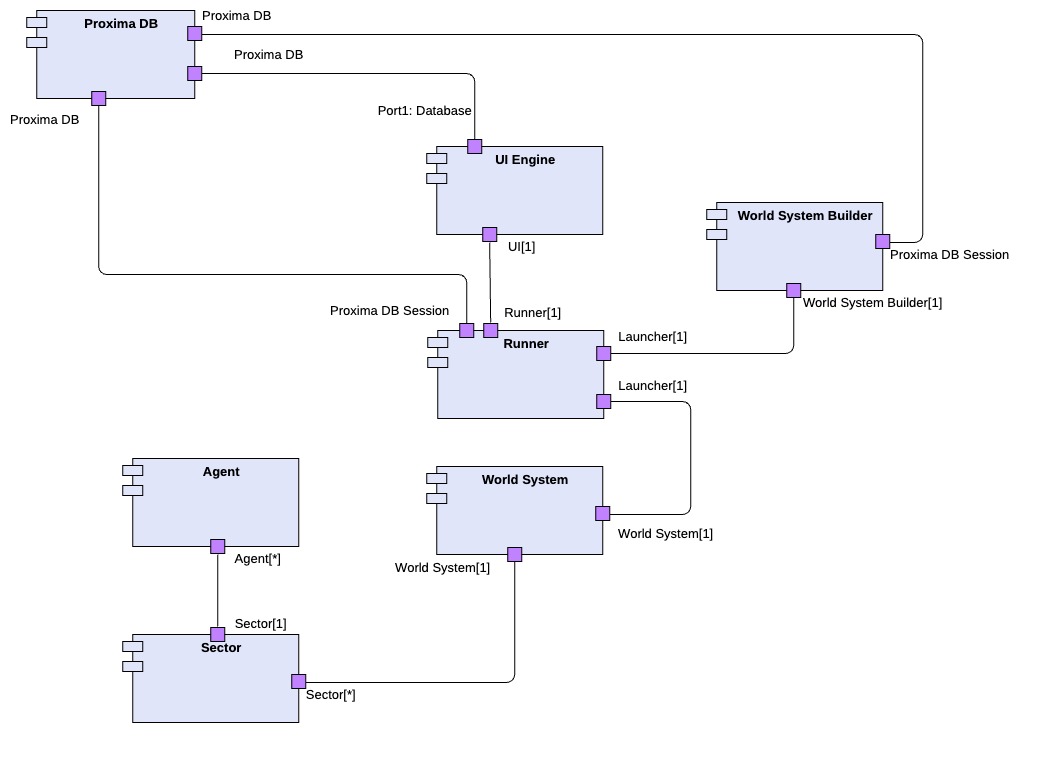
Figure 2 Proxima Model Component Diagram
Proxima DB:
Thin MongoDB wrapper that manages configuration/state documents (environments, component templates, world systems, policies, goals, events, experiments) and a time-series simulation log. Provides CRUD helpers, JSON import/export, and a simple CLI for dump/restore.
Proxima UI Engine
Dash-based dashboard that reads simulation logs, flattens sector metrics for plotting, builds sector summary tables, and sends control commands by inserting into MongoDB command collections.
World System Builder
Assembles a complete world system configuration from DB documents by resolving templates and composing per-sector agent configs; also loads goals and computes combined sector priorities for downstream scheduling and power allocation.
World System
Mesa Model orchestrator that initializes sectors, computes goal-weighted allocations, dispatches power/priorities to sectors each step, and aggregates sector metrics into a unified model metrics structure.
Proxima Runner
Simulation loop controller that builds the config, instantiates World System, runs continuous or limited steps, processes DB-driven commands (startup/runtime), and logs sector metrics plus runner state each step.
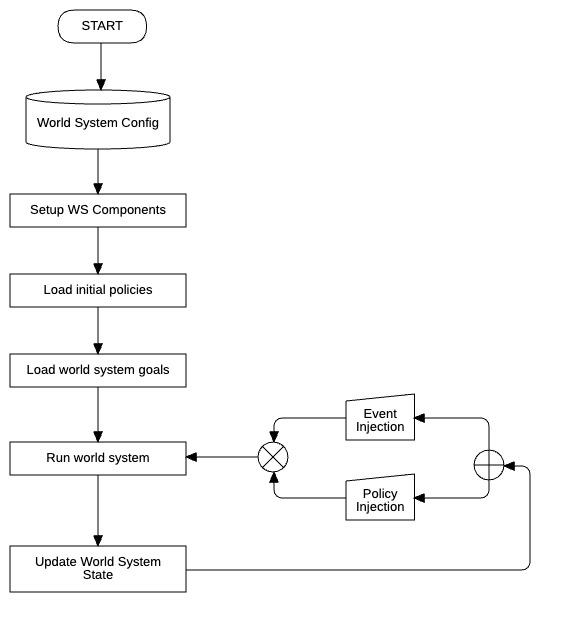
Figure 3 Proxima Model Operation Flow
Evaluation Engine
Provides centralized metric evaluation, scoring, and performance tracking. Decoupled from WorldSystem for better separation of concerns.
Policy Engine
Extensible policy engine that centralizes scoring and applies operational policies to the simulation world. Manages dynamic throttling and other adaptive behaviors based on world system metrics.
Policy Protocol: Interface for pluggable policies
PolicyEngine: Central manager for policy registration and application
Built-in Policies: Pre-configured policies like dust coverage throttling
Sectors
For creating a new sector, refer to World System documentation.
Sector |
Documentation Link |
|---|---|
Construction Sector |
|
Energy Sector |
|
Equipment Manufacturing Sector |
|
Manufacturing Sector |
|
Science Sector |
|
Transportation Sector |
Dynamical Architecture
This section covers the dynamical aspects of the world system. The dynamics might be world system equations identified as a result of policy flow and system identification, or may be equations used for various world system functional operations.
For each scenario, the dynamics are assessed against Proxima Model equations with hollistic view defined in the Exploring the Long Future and Survival of Human Civilization
Dynamics
TBD - Needs to be added
Policies
The simulation includes an adaptive Policy Engine that applies operational policies based on real-time system performance. These policies can dynamically adjust sector parameters to mitigate risks or optimize for specific goals.
Policy Category |
Documentation Link |
|---|---|
Environmental Policies |
|
Science Policies |
|
Manufacturing Policies |
|
Economic Policies |
Proxima Capabilities
Phases
With each phase/component, the world system will have:
Define physical architecture
Define functions to be performed
Perform studies on existing function on Earth
a. What is working
b. What is not working
c. Historical patterns
d. Distilled complexity science conceptsDefine goals against which world system performance will be measured.
Define policies based on goals and historical patterns.
Define Dynamics of the system
Run system identification. Match with world system mathematical models and update. Use Reduced Order Models (ROMs)
List all assumptions and simplifications
Define measures of performance
Define world system characteristics to monitor
Perform sensitivity analysis
Apply adaptive policy control and re-enforcement learning.
Appendix A: Tools and Techniques
Tool |
Use Case |
|---|---|
Mesa 3.0 |
|
SimPy |
|
Plotly | Dash |
REFERENCES
ISRU EXTRACTION and PROCESSIGN
https://spacenews.com/interlune-plans-to-gather-scarce-lunar-helium-3-for-quantum-computing-on-earth/